Setup
Sim Racing for Beginners: A UAE Starter Guide
A genuine beginner's path into sim racing, covering seating, braking technique, racing lines, assists, and a 30-day practice plan for UAE drivers.
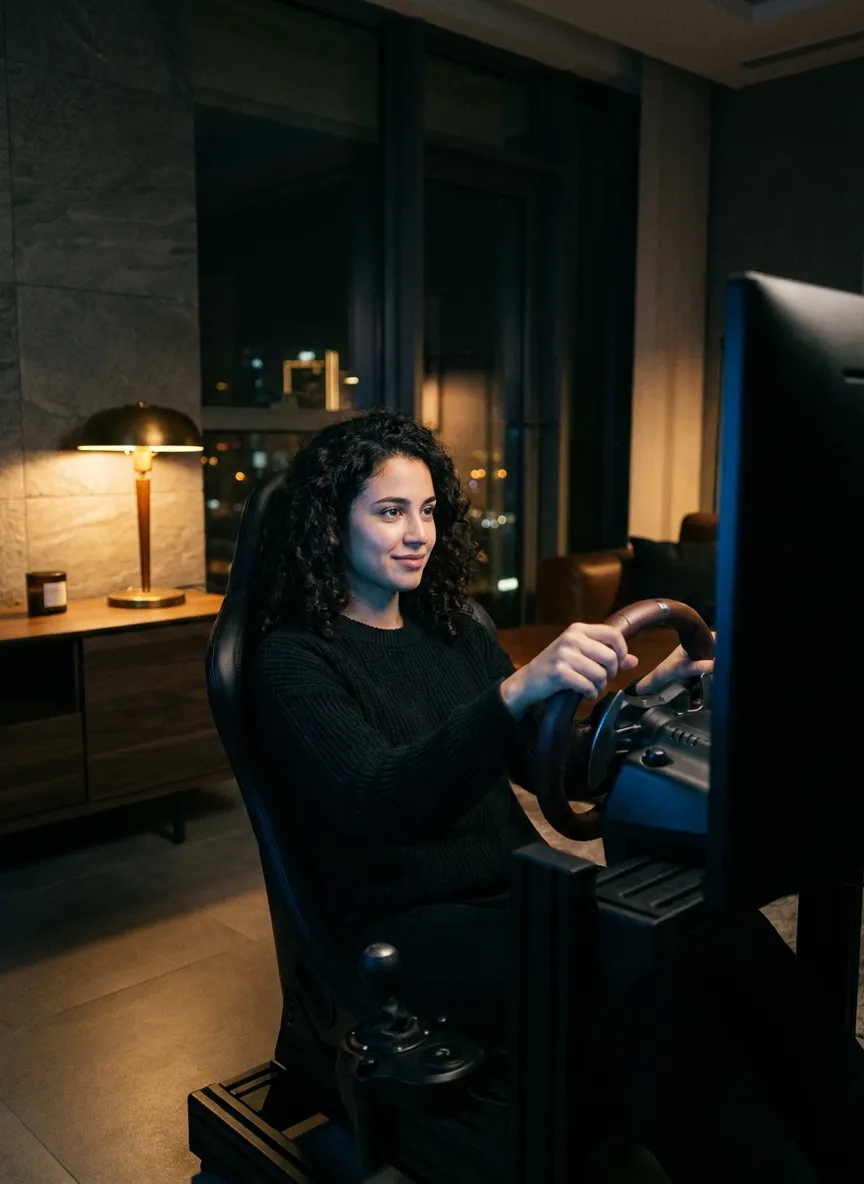
Sim racing for beginners in the UAE starts with three fundamentals: a correct seating position with relaxed hands, driving slower cars first to build clean technique, and using assists like traction control and ABS until car control feels natural. Skill develops through short, focused practice sessions rather than long unstructured ones, and most beginners see a real jump in consistency within their first month.
Sim racing looks intimidating from the outside, with drivers threading corners at speeds that seem impossible to control. In practice, it is a learnable skill like any other, built through repetition and a handful of core techniques. This guide lays out a genuine starting point, not a highlight reel of advanced driving.
What is sim racing, actually?
Sim racing is driving realistic car physics on a computer using hardware, typically a force feedback wheel and pedal set, designed to replicate real driving inputs and sensations. Unlike arcade racing games, sim titles model tyre grip, weight transfer, and braking physics closely enough that techniques learned on a rig transfer meaningfully to real driving, and vice versa.
The appeal for most newcomers is the combination of genuine skill progression and accessibility — you can meaningfully improve without needing a racetrack, a real car, or significant risk. A home racing simulator makes this accessible in a spare room or corner of a living space, rather than requiring a dedicated facility.
Seating position and hand placement
Getting the basics of posture right before you start driving saves weeks of bad habits later.
- Seat distance — sit close enough that your arms have a slight bend at the elbow with hands on the wheel, similar to a real car; sitting too far back forces you to lean forward under braking, which is both uncomfortable and inaccurate.
- Hand position — hold the wheel at roughly nine and three o'clock, or slightly below at eight and four, keeping hands still on the rim rather than constantly repositioning between inputs.
- Pedal reach — your foot should reach full brake travel without your leg fully extending; a cramped or overstretched pedal position makes consistent braking pressure much harder to judge.
- Seat height and angle — a slightly reclined seat, closer to a road car than an upright office chair, reduces fatigue over longer sessions and matches the sightline most sim titles are designed around.
If your cockpit is adjustable, spend your first session dialling in position before worrying about lap times. A wrong seating position undermines every technique covered below.
Why start with slower cars?
New sim racers often want to jump straight into the fastest, most powerful cars available, and it is almost always the wrong instinct. Slower, lower-powered road cars are far more forgiving: they have more grip relative to their power, punish mistakes less severely, and give you time to think through corners rather than reacting on instinct alone.
Building clean habits in a forgiving car transfers upward. A driver who can lap consistently and cleanly in a slow road car adapts to faster machinery quickly, because the underlying technique — braking points, racing lines, smooth inputs — is the same regardless of power. A driver who starts in a fast car without those fundamentals tends to develop compensating bad habits, like over-correcting slides or braking too early out of fear, that are harder to unlearn later.
Braking technique and trail braking
Braking is where most beginner lap time is lost or won, and it deserves more deliberate practice than any other single skill.
- Straight-line braking first — practice braking hard in a straight line before a corner, focusing on smooth, progressive pedal pressure rather than stabbing the brake.
- Find your braking point — use a fixed reference, like a marker board or track feature, so you brake at a consistent point lap after lap rather than guessing.
- Release smoothly — ease off the brake as you approach the corner rather than releasing it abruptly, which keeps the car's weight settled and the front tyres loaded for turn-in.
- Introduce trail braking — once straight-line braking feels consistent, practice easing off the brake gradually while beginning to turn in, rather than releasing fully before turning; this keeps grip available at the front axle for longer and is how experienced drivers carry more speed into a corner.
Trail braking is an intermediate skill. Do not force it in your first week — build clean straight-line braking first.
Racing lines: the geometry of going fast
A racing line is the path through a corner that carries the most speed with the least steering input. The classic principle is "slow in, fast out" — sacrificing a little entry speed to straighten the corner and get back on the throttle earlier, since a earlier throttle application usually gains more time than a faster entry loses.
Most corners follow a similar shape: a wide entry point, a clipping point near the inside of the corner roughly at its middle, and a wide exit that uses the full width of the track. Learning this shape on a handful of corner types transfers to nearly every track you drive afterward, because corner geometry repeats far more than beginners expect.
Reading force feedback
Force feedback is the wheel physically communicating what the car's tyres are doing, and learning to read it is arguably the biggest advantage sim racing has over a controller. As a rule of thumb:
- Increasing resistance through a corner usually signals building grip and load — a good sign you can carry more speed.
- A sudden lightening of the wheel often signals the front tyres losing grip, a cue to ease off steering or braking input.
- Vibration or chatter through the wheel typically indicates a kerb, rough surface, or the edge of available grip.
Spend deliberate practice time simply feeling these signals in a slow car, before worrying about lap times. This is a skill that a controller cannot teach at all, which is part of why a genuine MOZA R5 direct drive setup accelerates learning compared to a gamepad.
Using assists, then removing them
Assists exist to make cars driveable while you learn, not as training wheels to be ashamed of.
| Assist | What it does | When to remove |
|---|---|---|
| Traction control | Reduces wheelspin under acceleration | Once you can feel throttle limits without it |
| ABS | Prevents wheel lock-up under braking | Once trail braking feels consistent |
| Stability control | Corrects slides automatically | Once you can catch a slide manually in a slow car |
| Racing line overlay | Shows a suggested line on track | Once you know the track layout from memory |
Remove one assist at a time, and only once the previous step feels comfortable. Removing everything at once is the most common reason beginners get discouraged and quit early.
Practice structure that actually works
Long, unfocused sessions build fewer skills than short, deliberate ones. A useful structure:
- Warm-up laps — a handful of laps just to settle into the car and track, not for lap time.
- Focused block — 15 to 20 minutes working on one specific thing, such as a single corner's braking point.
- Race simulation — a short race or time trial to apply what you just practiced under pressure.
- Review — a few minutes reflecting on what felt inconsistent, ideally noted down for the next session.
This structure works far better than simply driving lap after lap hoping for improvement.
Joining UAE sim racing communities
Sim racing improves faster in company than alone. The UAE has an active scene through online leagues, Discord communities built around specific games, and organised events that welcome newcomers regardless of current skill level. Racing against others, even informally, surfaces habits and weaknesses that solo lapping never reveals, since a competitor in the mirror changes decision-making under pressure in ways a stopwatch alone does not. Ask in community channels for beginner-friendly leagues, which typically use slower cars and more forgiving formats specifically to welcome new drivers.
Your first month: a 30-day practice plan
- Days 1-3: Set up seating position and pedal reach; drive a slow car with all assists on, focused purely on comfort and control.
- Days 4-7: Practice straight-line braking points on one track, using a fixed visual reference each lap.
- Days 8-12: Learn racing lines for that same track, corner by corner, still with assists on.
- Days 13-16: Remove traction control; adjust to the extra wheelspin sensitivity in the same slow car.
- Days 17-21: Introduce trail braking on two or three corners where it suits the geometry.
- Days 22-25: Remove ABS; rebuild braking confidence using the technique from days 4-7.
- Days 26-28: Try a second track to test whether your fundamentals transfer, not just memorised habits.
- Days 29-30: Attempt a short race or online session, applying everything practiced, and note what to focus on next month.
Realistic expectations matter here. You will not be fast by day 30 — you will be consistent, which is the foundation everything else is built on.
Getting the right hardware for learning
Technique progresses fastest on hardware that actually communicates what the car is doing, which is why we install genuine direct drive systems rather than entry-level alternatives. For guidance on specifying a first rig properly, read our best home racing simulator setup guide, our MOZA R5 review, and our breakdown of whether a racing simulator is worth it for a beginner specifically.
Booking a consultation
If you are ready to start properly rather than on a borrowed controller, a consultation is the right next step. We assess your space and goals, then deliver a complete, calibrated rig ready to drive from day one anywhere in Dubai and the UAE. Contact us to book one, or read more about our installation process and about page first.
Questions
Quick answers.
How long does it take to get good at sim racing?
Most beginners see a noticeable jump in consistency within the first month of regular, focused practice, though genuine competitive pace typically takes several months of structured driving. Progress depends far more on deliberate practice than raw hours logged, so short focused sessions beat long unfocused ones.
Should beginners use racing assists like traction control and ABS?
Yes, beginners should start with assists like traction control, ABS and stability control switched on, since they let you focus on racing lines and braking points without being overwhelmed by car control. Assists should be removed one at a time as confidence builds, not all at once.
What car should a beginner start with in sim racing?
Slower, lower-powered road cars are the best starting point, because they are more forgiving of mistakes and let you build racing lines and braking technique without the car constantly trying to spin. Move to faster, higher-downforce cars only once you can consistently complete clean laps in a slower car.
Are there sim racing communities in the UAE?
Yes, the UAE has an active sim racing scene through online leagues, Discord communities and organised events that welcome newcomers of all skill levels. Joining a community accelerates learning significantly, since structured racing against others surfaces habits that solo practice never reveals.
Do I need a force feedback wheel to learn sim racing properly, or can I start with a controller?
A controller is a fine way to try sim racing casually, but a force feedback wheel and pedal set teaches genuine car control far faster, because it communicates weight transfer, grip loss and braking pressure in ways a controller physically cannot. If you are serious about improving, moving to a wheel and pedals early avoids relearning fundamentals later.
What is trail braking and when should a beginner learn it?
Trail braking is easing off the brake pedal gradually while beginning to turn into a corner, rather than releasing it all at once before turning. It is worth learning once basic straight-line braking and racing lines feel comfortable, typically a few weeks into regular practice, not on day one.
Keep reading
 Racing Simulator Maintenance Guide: Keeping Your Rig Performing
How to maintain a direct drive racing simulator in the UAE, from firmware updates and pedal care to desert dust management and a full maintenance schedule.
Read more →
 Racing Simulator Space Requirements: How Much Room Do You Actually Need?
How much floor space, ceiling height, and access a home racing simulator actually needs, plus how to measure your room before booking installation.
Read more →
 Direct Drive vs Belt Drive Racing Wheels: What's the Real Difference?
Gear, belt, and direct drive wheels explained in plain language, covering torque, feedback detail, noise, and which one actually suits how you drive.
Read more →
Ready to build your racing room?
Book a free, no-obligation consultation. We'll scope your space and come back with a clear plan.