Setup
Racing Simulator Space Requirements: How Much Room Do You Actually Need?
How much floor space, ceiling height, and access a home racing simulator actually needs, plus how to measure your room before booking installation.
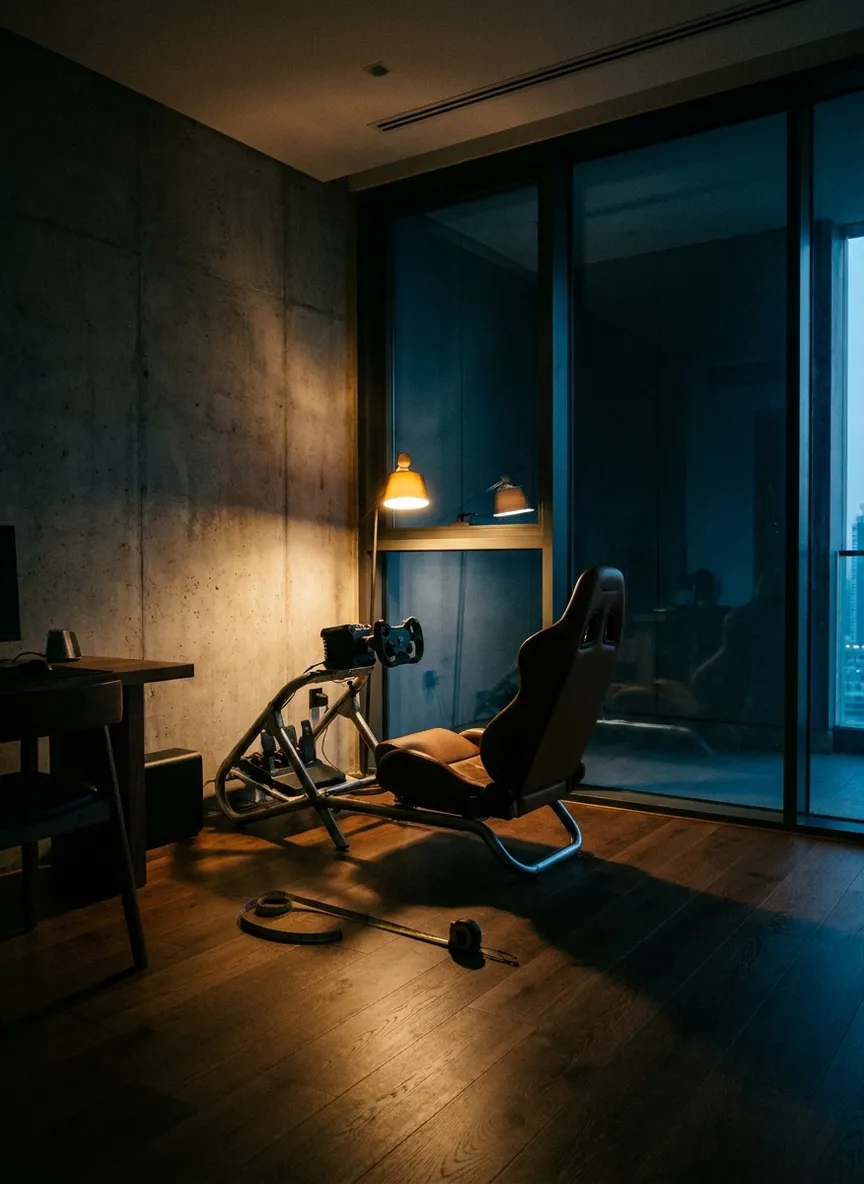
A racing simulator needs a minimum of roughly 2 by 2 metres of clear floor space, a ceiling height of at least 2.2 metres, and doorway access wide enough for an assembled or part-assembled cockpit to pass through. Beyond the bare minimum, a comfortable setup benefits from extra clearance behind the seat, a nearby power socket, and a room that can stay reasonably cool during longer sessions.
Getting the space right before delivery day matters more than most people expect — it's the difference between a rig that feels natural to use daily and one that gets awkward to sit in after the first few sessions. Here's what to actually measure and think about.
How much floor space does a racing simulator need?
The cockpit footprint itself is usually the smallest part of the equation; what takes up the rest of the space is the clearance around it for getting in, out, and moving comfortably during a session.
| Space category | Floor area | Ceiling height | What it allows |
|---|---|---|---|
| Minimum | ~2m x 2m | 2.2m | Cockpit fits, tight clearance to sit and stand, limited screen distance |
| Comfortable | ~2.5m x 3m | 2.4m | Easy access, proper screen distance, room to stand beside the rig |
| Ideal | 3m x 3.5m+ | 2.6m+ | Space for a TV or triple-screen setup, storage nearby, room to spectate |
These are general planning figures rather than fixed requirements, and the right number for your home depends on cockpit style, screen choice, and how the room is otherwise used. A dedicated spare room, home office corner, or a section of a majlis or games room can all work well.
What ceiling height do I need?
Most cockpits sit low to the ground, so ceiling height is rarely a hard constraint, but it becomes relevant once you factor in a mounted monitor or TV arm and the natural seated height of an adult driver. As a rule of thumb, 2.2 metres is a workable minimum, and anything above 2.4 metres removes the issue entirely. Rooms with ceiling fans or low-hanging light fittings are worth checking specifically, since these are easy to overlook until the rig is already in place.
Will my doorway allow delivery access?
This is one of the most overlooked practicalities, and it's worth checking before booking rather than after. A racing cockpit is a large, rigid structure, and while components are typically assembled on-site rather than delivered fully built, some sections still need to pass through doorways, corridors, and — in apartments — a lift.
- Standard doorways (around 80cm wide) are generally sufficient for component-by-component delivery.
- Lift access matters for upper-floor apartments; a lift that's too small for larger boxed components can add time to a delivery, so it's worth mentioning during booking.
- Stairwells are workable but should be flagged in advance if there's no lift, particularly above the second or third floor.
- Tight corners or narrow hallways between the entrance and the installation room are the most common cause of delivery day surprises.
None of these rule out an installation — they simply need to be known ahead of time so the team can plan accordingly. This is exactly what the consultation phase of the installation process is for.
What about power sockets and cable management?
A direct drive simulator setup typically needs power for the wheelbase, the PC (if included), the monitor or TV, and any peripherals like speakers. As a rule of thumb, having at least one dedicated double socket within reach of the cockpit avoids a tangle of extension leads across the floor, which is both a trip hazard and visually messy.
- Position the rig near an existing socket where possible, rather than planning to run new wiring.
- A cable tidy or under-desk tray keeps wheelbase, pedal, and shifter cables from tangling underfoot.
- If a PC is part of the setup, consider ventilation clearance around it — direct drive motors and gaming PCs both generate heat during use.
- Surge protection is sensible for any setup running sensitive electronics for extended sessions.
Does flooring or vibration matter?
Direct drive wheels transmit torque through the entire cockpit frame, and a rigid, stable floor helps that torque translate into feel rather than being absorbed or wobbling the rig. Concrete floors under carpet or tile generally perform well. Suspended timber floors, common in some villa upper storeys, can transmit vibration to the room below during hard force feedback events, which is worth a moment's thought if the room underneath is a bedroom or living space. A dense rug or simple floor pad under the cockpit legs can help in these cases.
How far should the screen be from the seat?
Screen distance and height affect both immersion and comfort over longer sessions. As a general guide, a single monitor typically sits somewhere between 70 and 90cm from the eyes, positioned so the top of the screen is roughly at eye level when seated in the racing position — not the upright desk-chair position most people default to. TVs, being larger, usually sit further back. Getting this distance right is part of what a professional monitor or TV mount installation accounts for, rather than eyeballing it on the day.
Does apartment living change anything versus a villa?
Both work well, but the considerations differ slightly.
- Apartments — lift access and doorway width are the main planning points; noise transmission to neighbours below is worth a thought if the unit isn't on the ground floor; balcony-adjacent rooms often have better natural cooling.
- Villas — more flexibility on room choice, but larger properties sometimes mean longer internal routes from the entrance to the installation room, which is worth mapping out in advance; garages and dedicated games rooms are common choices.
- Either setting — ventilation and air conditioning coverage matter regardless of property type, particularly given Dubai's climate; a room without decent airflow will get warm quickly during a long racing session with a PC and direct drive motor both running.
Apartment towers in Dubai Marina, villas in Emirates Hills and family homes in Arabian Ranches each bring their own small quirks that get resolved at the consultation stage rather than on delivery day.
What about heat and air conditioning in a UAE home?
Dubai's climate makes ventilation a more practical concern here than it might be elsewhere, and it's worth factoring into room choice rather than treating it as an afterthought. A direct drive motor generates heat during sustained use, and a gaming PC — particularly one running a demanding sim racing title at a high frame rate — adds meaningfully to that. In a room with poor airflow or limited air conditioning coverage, a long session can get uncomfortably warm surprisingly quickly, which affects both driver comfort and, over time, the operating temperature of the electronics themselves.
Rooms that already have reliable AC coverage, or reasonable natural cross-ventilation, are the easiest choice. Converted storage rooms, enclosed garages, and rooms at the end of a long ducting run from a central AC unit are worth testing during a warm part of the day before committing, since these are the spaces most likely to underperform once equipment is installed and running.
Should the rig face a window or an enclosed wall?
This is a smaller consideration but worth a mention. Direct sunlight on a monitor or TV screen washes out contrast and makes fine detail — kerbs, track markings, mirrors — harder to read, so positioning the rig with the screen facing away from a bright window, or fitting blackout curtains for daytime sessions, noticeably improves the experience. An enclosed wall behind the screen also tends to look and feel more immersive than a window view, since peripheral distraction is one of the easier things to eliminate in an otherwise well-planned space.
How do I measure my room before booking a consultation?
You don't need to be precise, but a rough sense of the space speeds up the consultation considerably.
- Measure the length and width of the room in metres, noting the location of doors and any fixed furniture.
- Note the ceiling height, particularly if there's a fan or low light fitting near where the rig would sit.
- Check the location of the nearest power socket relative to where you'd place the cockpit.
- Photograph the room from a couple of angles, including the doorway and any corridor leading to it.
- Note whether the space is served by air conditioning and whether it's used regularly.
Bringing this information to your consultation — even informally — means the order processing and procurement stage can begin with confidence that the space will work as planned.
Not sure your room is big enough?
Most rooms work better than people expect, and awkward spaces are usually solvable rather than disqualifying. The fastest way to find out is a short conversation about your specific room. Contact us to book a consultation, browse the gallery for real installation examples, or read about what a racing simulator actually costs in Dubai once your space is confirmed.
Questions
Quick answers.
What is the minimum room size for a racing simulator?
As a rule of thumb, a minimum usable footprint is around 2 by 2 metres, which allows the cockpit itself plus enough clearance to sit down, get up, and reach the pedals comfortably. Tighter spaces can work but limit screen distance and make cable routing harder.
Can a racing simulator fit in an apartment in Dubai?
Yes, most apartments have a spare room, study, or balcony-adjacent corner that works, provided there's a lift or manageable stairwell for delivery and a standard door width for the cockpit to pass through. This is discussed during the consultation stage so there are no surprises on installation day.
Do I need special flooring under a direct drive simulator?
Not usually, but a stable, level surface makes a noticeable difference to how a rigid cockpit performs under torque. Carpet over concrete is generally fine; suspended timber floors can transmit some vibration to the room below, which is worth considering in apartments.
How far should I sit from the screen on a racing simulator?
As a general guide, single-monitor setups typically sit around 70 to 90cm from the eyes, close enough for the screen to fill more of your peripheral vision without needing to turn your head to see the mirrors. Exact distance depends on screen size and is confirmed during installation.
Does a racing simulator need air conditioning or ventilation?
Direct drive motors and gaming PCs both generate heat, and Dubai's ambient temperature means a room without adequate air conditioning can get uncomfortably warm during extended sessions. Reasonable airflow or existing AC coverage is worth checking before committing a room to a simulator.
Keep reading
 Racing Simulator Maintenance Guide: Keeping Your Rig Performing
How to maintain a direct drive racing simulator in the UAE, from firmware updates and pedal care to desert dust management and a full maintenance schedule.
Read more →
 Sim Racing for Beginners: A UAE Starter Guide
A genuine beginner's path into sim racing, covering seating, braking technique, racing lines, assists, and a 30-day practice plan for UAE drivers.
Read more →
 Direct Drive vs Belt Drive Racing Wheels: What's the Real Difference?
Gear, belt, and direct drive wheels explained in plain language, covering torque, feedback detail, noise, and which one actually suits how you drive.
Read more →
Ready to build your racing room?
Book a free, no-obligation consultation. We'll scope your space and come back with a clear plan.