Technical
Direct Drive vs Belt Drive Racing Wheels: What's the Real Difference?
Gear, belt, and direct drive wheels explained in plain language, covering torque, feedback detail, noise, and which one actually suits how you drive.
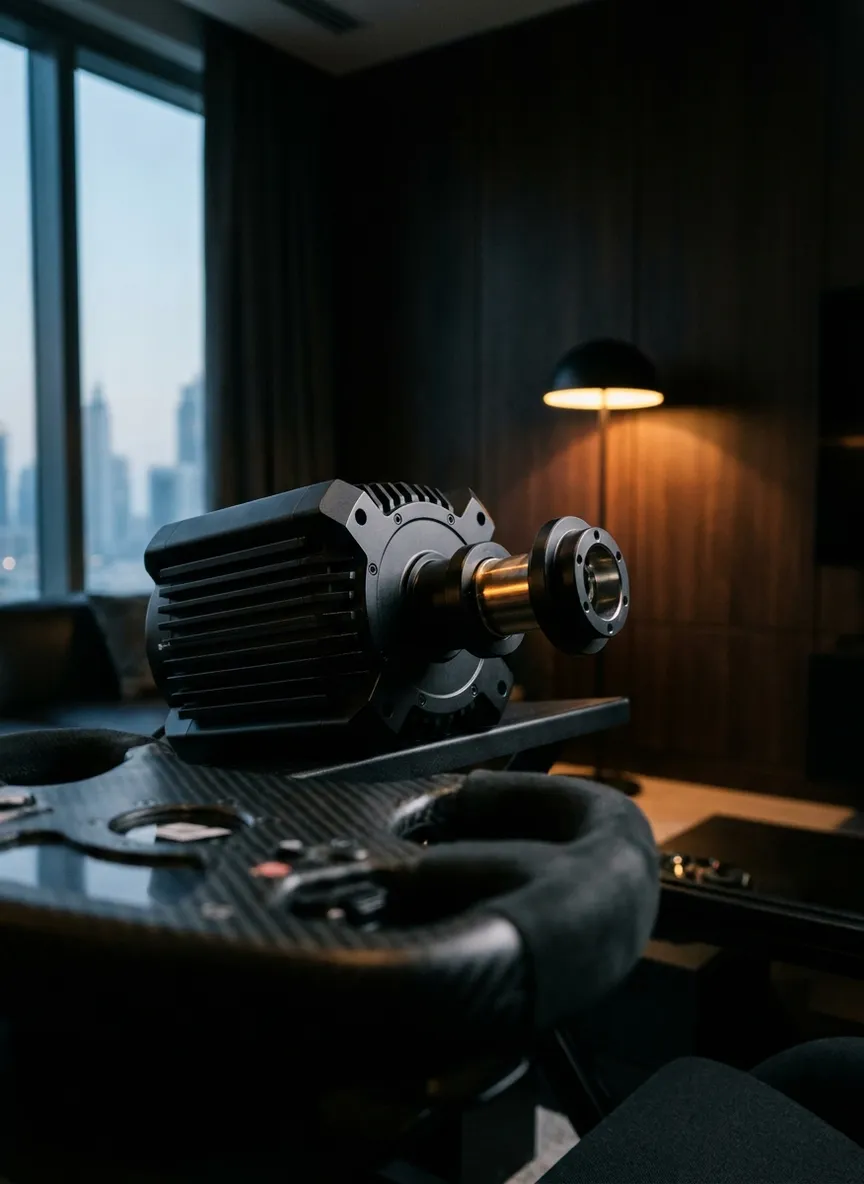
Direct drive wheels connect the motor straight to the steering shaft, giving the sharpest, most detailed force feedback with almost no delay. Belt-driven wheels use a reinforced belt between motor and rim, offering a smoother feel than gear-driven wheels but with some mechanical play that grows over time. Gear-driven wheels sit at the entry level, using plastic or metal gears that introduce noticeable backlash and a less realistic feel.
The difference between these three technologies is the single biggest factor in how a racing simulator actually feels to drive, more than screen size, seat comfort, or even which game you're playing. Here's what's actually happening inside each type, and how to think about torque, latency, and longevity when comparing them.
How does force feedback actually work?
Force feedback is the wheel pushing back against your hands to simulate what a real steering rack would transmit from the road, the tyres, and the car's suspension. The game engine calculates forces dozens of times per second — grip loss, kerb strikes, weight transfer under braking — and sends that data to the wheel's motor, which converts it into physical resistance and vibration at the rim.
How faithfully that data survives the trip from motor to your hands depends entirely on what sits between them. Every gear tooth, every millimetre of belt stretch, every bit of mechanical play absorbs and blurs some of that signal before it reaches you. This is the core reason drive type matters more than almost any other spec.
What's the actual difference between gear, belt, and direct drive?
| Factor | Gear-driven | Belt-driven | Direct drive |
|---|---|---|---|
| Mechanism | Motor through plastic/metal gears | Motor through reinforced belt | Motor mounted directly on wheel shaft |
| Feedback detail | Low — gear backlash blurs fine detail | Moderate — smoother than gears | High — near-immediate, textured detail |
| Latency | Noticeable | Reduced | Minimal |
| Noise | Whining, mechanical | Quieter, occasional belt hum | Quiet in normal use, sharp on hard hits |
| Longevity | Gears wear and develop play | Belt stretches over months of use | Fewer moving parts, less to degrade |
| Mounting needs | Desk clamp usually sufficient | Semi-rigid mount recommended | Rigid, rated cockpit required |
| Typical AED range | 2,500 – 4,000 | 5,000 – 9,000 | 8,000 – 20,000 |
Gear-driven wheels
Gear-driven wheels are the most affordable way to add force feedback to a setup, and for casual arcade racing they do the job. The gear teeth engage and disengage as the motor spins, which introduces backlash — a small dead zone where the wheel briefly doesn't respond to input or output. That dead zone is what makes gear-driven wheels feel notchy rather than fluid, and it becomes more noticeable the more time you spend behind the wheel.
Belt-driven wheels
A reinforced belt replaces the gear train, wrapping around a pulley connected to the motor and another connected to the wheel shaft. Because a belt has no teeth to mesh, there's far less backlash than a gear system, and the feel is noticeably smoother — this is why belt-driven wheels are the common mid-tier choice for enthusiasts who want more than entry-level but aren't ready for direct drive pricing. The trade-off is that belts are a wear item: tension loosens gradually with use, and that reintroduces some play months or years down the line. Belt-driven wheels also have a practical torque ceiling, since a belt can only transmit so much force before it slips or stretches under load.
Direct drive wheels
Direct drive removes the belt and gear entirely. The motor's rotor is the wheel shaft — there is no intermediate mechanism to introduce play, absorb detail, or wear out. This is why direct drive is the standard in professional sim racing and increasingly the expectation in serious home setups: the force feedback you feel is the closest software representation of what the game engine is calculating, arriving with minimal delay and full resolution. The MOZA R5 Direct Drive sits at the accessible end of this category, built specifically to bring that fidelity into a home installation rather than a competition-grade rig.
What does torque (Nm) actually mean at the wheel rim?
Torque, measured in newton-metres, describes how much rotational force a wheel's motor can generate. In practical terms, higher torque means the wheel can push back harder and with more nuance during high-load moments — hard cornering, sudden kerb strikes, wheelspin under acceleration. A low-torque wheel might blunt these events into a general vibration, while a higher-torque direct drive wheel can render them as distinct, readable sensations.
As a rule of thumb, torque figures matter less in isolation and more relative to how the wheel is mounted. A high-torque wheel bolted to a flexing frame will lose much of that force to the frame itself instead of your hands, which is why cockpit rigidity is treated as a non-negotiable part of any direct drive installation rather than an optional extra.
Does latency actually matter for casual driving?
Latency is the delay between something happening in the simulation and you feeling it at the wheel. For fast reactive driving — catching a slide, feeling grip disappear before you see the car step out — even a small delay changes how naturally you can respond. Direct drive's near-elimination of latency is arguably the single biggest reason it feels different from belt or gear-driven wheels, more than the torque figure alone. Drivers who've only used gear-driven wheels often describe their first direct drive session as feeling like the car is talking to them in real time rather than a beat behind.
Is direct drive too strong or intense for a beginner?
This is a common concern, and it's a reasonable one to raise, but it's addressed in software rather than hardware. Force feedback strength, damping, and understeer/oversteer effects are all adjustable per game, and professional calibration typically starts a new driver well below the wheel's maximum output. As comfort and skill build, the strength can be increased gradually. In other words, a direct drive wheel scales down for a beginner far more gracefully than a gear-driven wheel scales up for an experienced driver — the ceiling is simply much higher on a direct drive system, not the floor.
Which drive type suits which kind of driver?
- Gear-driven suits occasional, casual players who want basic feedback without a large investment, and who are unlikely to notice or mind reduced detail.
- Belt-driven suits enthusiasts who drive regularly and want a noticeable step up in feel without committing to direct drive pricing or cockpit requirements.
- Direct drive suits anyone serious about realism, skill-building, or regular use — including drivers who want their simulator time to genuinely carry over to real-world car control, a topic we cover in is a racing simulator worth it.
What about safety and mounting requirements?
Drive type doesn't just change how a wheel feels — it changes what it demands structurally. Gear-driven wheels, being relatively low torque, are generally safe on a standard desk clamp, though repeated use can loosen the clamp over time. Belt-driven wheels benefit from a semi-rigid mount, since their higher torque ceiling starts to expose the limits of a simple desk clamp during hard cornering forces.
Direct drive wheels are a different proposition entirely. Because there's no belt or gear absorbing any of the torque, all of it reaches the mounting point, which means a flexible or poorly secured frame doesn't just feel worse — it can be genuinely unsafe over time, working loose or placing uneven stress on fixings. This is why a rated cockpit, not a desk clamp, is treated as a required part of any direct drive installation rather than a premium add-on. It's also why professional installation matters: a cockpit that looks similar to a rated one but isn't built to the same tolerance won't reveal the problem until months of regular use have gone by.
How does noise actually differ day to day?
Noise is often underestimated when comparing drive types, particularly for anyone installing a rig in a shared living space or an apartment. Gear-driven wheels tend to produce a constant, low mechanical whine during use, which becomes background noise quickly but is rarely silent. Belt-driven wheels are quieter in steady-state driving, with an occasional soft hum from the belt itself, though this can become more noticeable as the belt ages and loosens slightly.
Direct drive wheels are usually the quietest of the three during smooth, controlled driving, since there's no belt friction or gear mesh generating continuous noise. The trade-off is that they can produce sharp, audible feedback during abrupt events — hitting a kerb hard, a collision, sudden wheelspin — because that same fidelity that makes direct drive feel realistic also means genuine impacts are rendered as genuine impacts, not smoothed out by mechanical slack. For most households this is a reasonable trade, but it's worth knowing before you install a rig in a room adjacent to a nursery or a light sleeper's bedroom.
How should you actually decide between the three?
If you're still weighing it up, a simple decision process helps more than comparing spec sheets in isolation:
- Be honest about frequency. Occasional, casual use rarely justifies direct drive pricing; regular use makes the case for it quickly.
- Check your space can take a rated cockpit. Direct drive's torque needs a rigid mount, not a desk clamp, so confirm your room can host one before comparing wheels on feel alone.
- Decide what you're optimising for. Budget and simplicity point toward gear or belt-driven; realism, skill-building, and longevity point toward direct drive.
- Factor in installation, not just hardware. A direct drive wheel installed and calibrated properly outperforms the same wheel set up casually, so weigh the full package rather than the wheelbase price alone.
Where does the MOZA R5 fit into this?
The MOZA R5 Direct Drive is positioned as an entry point into genuine direct drive performance, rather than a professional-grade wheel priced for racing teams. It delivers the core advantages of the category — low latency, high feedback resolution, minimal mechanical wear — in a package sized and priced for serious home use. Full specifications live on the MOZA R5 racing simulator page, and if you're comparing overall setup pricing across tiers, our guide on how much a racing simulator costs in Dubai puts the R5 in context against gear and belt-driven alternatives.
Because direct drive wheels need a rigid mounting point to perform correctly, installation matters as much as the hardware itself. Every turnkey package from Desert Drift Kings includes a cockpit rated for direct drive torque and full calibration on-site — details are on the racing simulator installation Dubai page, alongside coverage under our 60-day warranty.
Considering direct drive for your own space?
If you're weighing up drive types against your budget and how you'll actually use the rig, a short consultation is the fastest way to get a straight answer rather than guessing from spec sheets. Contact us to talk through your options, or see completed installations in the gallery first.
Questions
Quick answers.
What does torque in Nm actually mean for a racing wheel?
Torque measured in newton-metres describes how much rotational force the wheel motor can apply at the rim. Higher torque means stronger, more detailed feedback and more resistance during hard cornering or kerb strikes, but it also demands a genuinely rigid cockpit to transmit that force instead of flexing under it.
Is a direct drive wheel too strong for a beginner?
Not if the force feedback strength is set correctly in software, which is standard practice during professional calibration. Most direct drive wheels, including the MOZA R5, can be tuned down considerably for a beginner and increased as confidence grows, so the hardware itself is not the limiting factor.
Do belt-driven wheels wear out faster than direct drive?
Generally yes. The belt itself stretches gradually with use, which reintroduces play and softens feedback over time, and it is a wear part that eventually needs replacing. Direct drive wheels have no belt or gear between motor and rim, so there is less to degrade mechanically.
Are direct drive wheels louder or quieter than belt-driven ones?
Direct drive wheels are typically quieter during smooth driving because there's no belt friction or gear mesh, but they can produce sharp, audible feedback during hard hits like kerbs or collisions, since that same detail is being fed directly into the motor rather than dampened by a belt.
Can I mount a direct drive wheel on a desk instead of a cockpit?
It is not recommended. Direct drive wheels generate enough torque to flex or damage a desk clamp over time, and the lack of rigidity also blunts the feedback quality that is the entire reason to choose direct drive. A rated cockpit is considered part of a proper direct drive installation.
Keep reading
 MOZA R5 Direct Drive Review: A UAE Owner's Perspective
An honest look at the MOZA R5 Direct Drive bundle from a UAE owner's perspective, covering feel, software, pedals, heat, noise and who it suits.
Read more →
 How Much Does a Racing Simulator Cost in Dubai?
A clear breakdown of racing simulator prices in Dubai, from entry-level gear-driven wheels to professional direct drive rigs, and the costs people forget.
Read more →
 Is a Racing Simulator Worth It? An Honest Cost-Per-Hour Breakdown
An honest look at whether a home racing simulator is worth it, comparing cost per hour, skill transfer, and longevity against karting and track days.
Read more →
Ready to build your racing room?
Book a free, no-obligation consultation. We'll scope your space and come back with a clear plan.