Buying Guide
The Best Racing Simulator Setup for Home in 2026
A specification guide to building a home racing simulator in 2026, from wheelbase torque to display strategy, with a good/better/best comparison table.
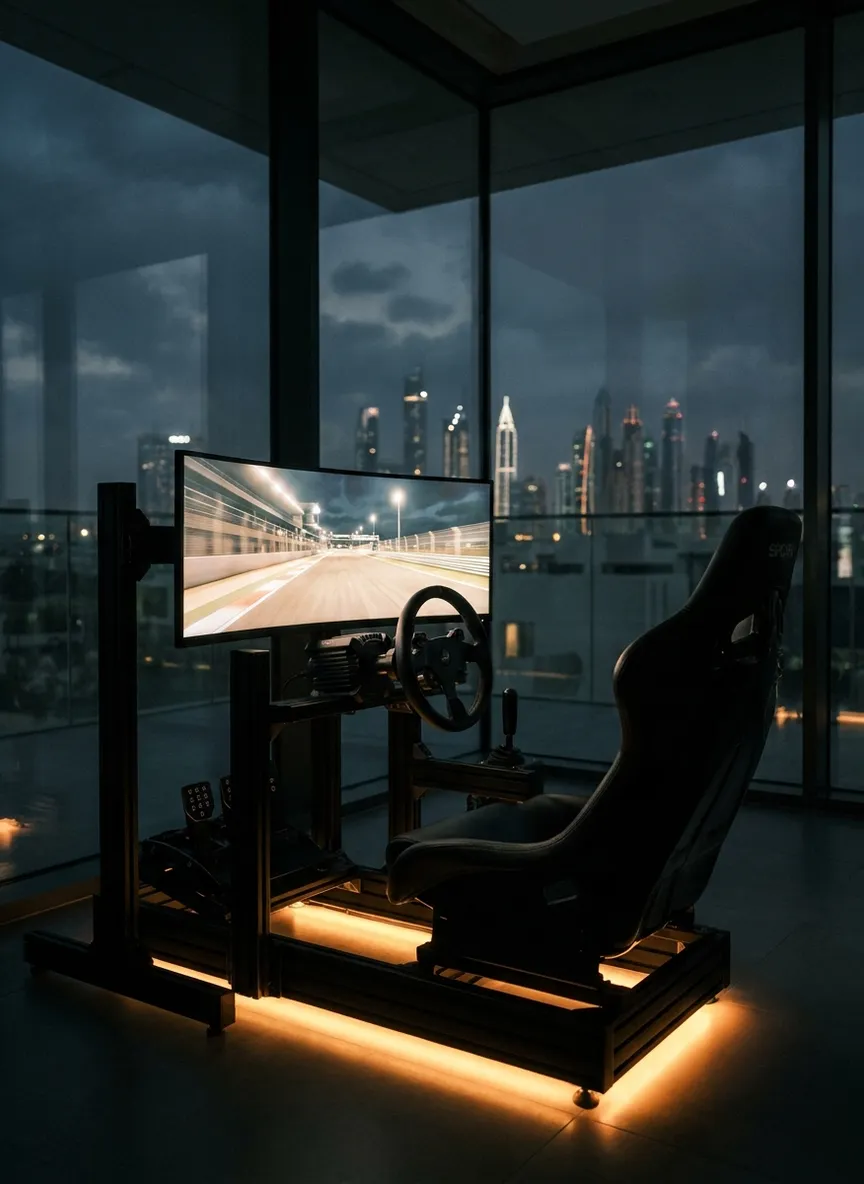
The best home racing simulator setup for 2026 pairs a direct drive wheelbase of at least 5 Nm with a load-cell brake pedal, a rigid aluminium-profile cockpit, and a display strategy sized to your room rather than your ambition. Everything else — shifters, handbrakes, haptics — is a genuine upgrade path, not a starting requirement. Get the wheelbase, pedals and cockpit right first, because those three decisions are the ones you will regret rushing.
Building a rig from a list of parts is where most people go wrong. A racing simulator is a system, and each component only performs as well as the one bolted to it. A powerful wheelbase mounted to a wobbly desk feels worse than a modest one bolted to steel. This guide walks through every layer of the build in the order it actually matters, so you can spend your budget where it counts and sequence upgrades sensibly.
What wheelbase should I buy for a home simulator?
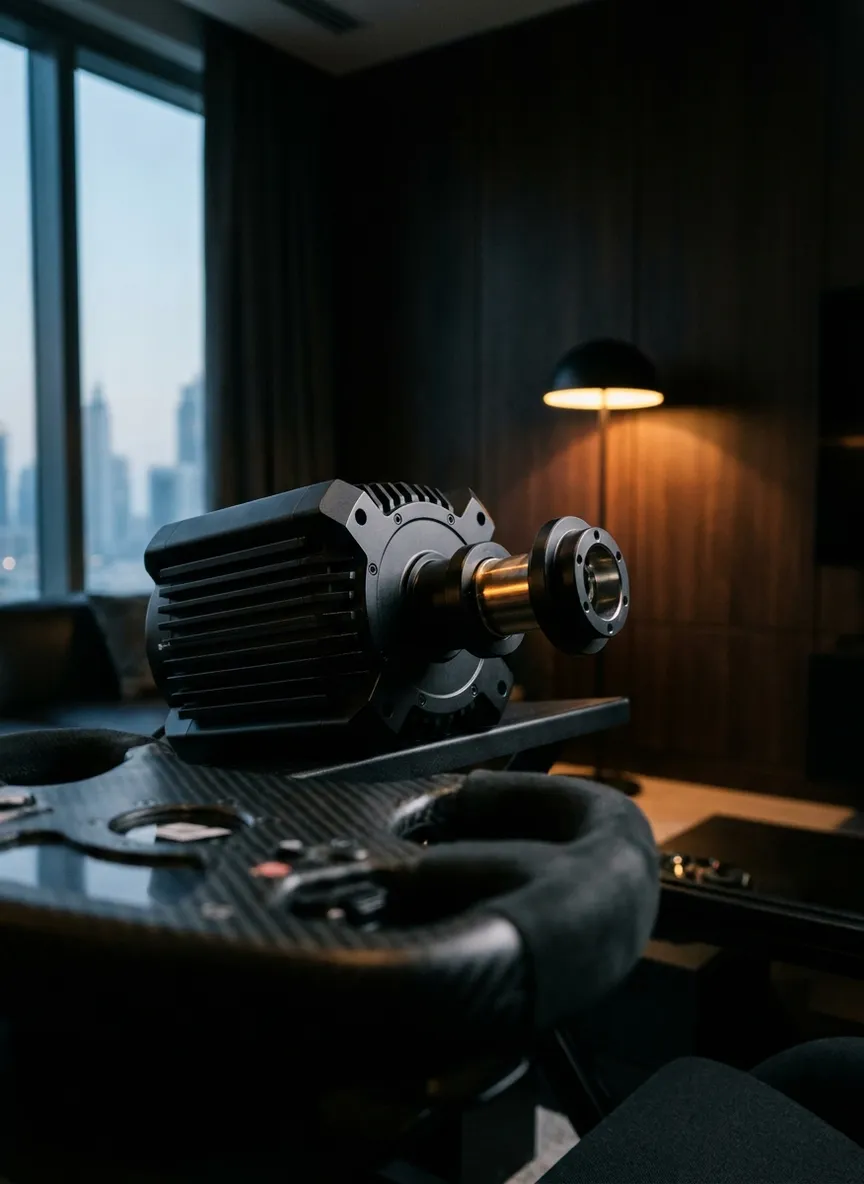
Wheelbase choice is the single decision that shapes everything downstream. Direct drive has replaced belt and gear-driven wheels as the standard for anyone serious about feel, because the motor connects straight to the wheel shaft with no belts, gears or rubber bushings to absorb detail.
- Entry direct drive (around 5-6 Nm): enough torque to feel kerbs, weight transfer and tyre slip clearly, without being physically tiring for daily use.
- Mid-range direct drive (8-10 Nm): noticeably crisper detail and stronger self-centring, useful once you are pushing higher-downforce cars.
- High-end direct drive (15 Nm+): aimed at drivers who want maximum fidelity or race in a highly physical style; genuinely more than most home users need.
For most first home installations, a wheelbase around the 5-8 Nm class is the sensible starting point. It is strong enough to teach proper technique and rewarding enough that you will not outgrow it in the first year. Drivers who already know they want more detail can start higher: we also install the 9 Nm MOZA R9 and 12 Nm MOZA R12 bundles (see pricing). If you want a deeper comparison of drive types, our guide to direct drive vs belt drive racing wheels covers the mechanical differences in detail, and our MOZA R5 review for the UAE looks at one specific bundle in this class from an owner's perspective.
Torque figures alone do not tell the whole story. How a wheelbase manages that torque, through its firmware and force feedback tuning, matters as much as the peak number on the box. Two wheelbases with identical torque ratings can feel completely different depending on how cleanly they reproduce fine detail like kerb rumble and tyre slip versus how much of that signal gets smoothed away. This is why demo experience or a trusted supplier's guidance is worth more than chasing the highest Nm figure you can afford. A well-tuned mid-range wheelbase, properly mounted, will consistently out-feel a stronger motor bolted to a flexing desk.
Wheel rim: does it matter as much as the wheelbase?
The wheel rim is the part of the system you actually hold, and it is easy to treat as an afterthought once the wheelbase decision is made. Rim diameter and shape should roughly match the type of car you drive most: a smaller GT-style rim suits circuit racing, while a larger rim with a flatter bottom suits rally and road-focused titles. Grip material also matters more over long sessions than most buyers expect — a rim with poor grip becomes noticeably uncomfortable after twenty or thirty minutes of hard cornering, regardless of how good the underlying wheelbase feels.
Pedals: potentiometer or load cell?
Pedals matter more than most first-time buyers expect. A potentiometer pedal measures how far you press, which is fine for throttle but imprecise for braking, where real cars respond to pressure, not distance.
A load-cell brake pedal measures force instead, so pressing progressively harder produces a progressive, repeatable braking curve, closer to how an actual brake pedal behaves. This is the upgrade that most reliably improves lap consistency, because braking is where most lap time is won or lost. If your budget allows only one premium component beyond the wheelbase, make it the brake pedal.
Shifter, handbrake and other add-ons
A manual shifter and handbrake are not essential for every driver, but they change what genres of racing feel authentic.
- H-pattern shifter — worthwhile if you enjoy rally, classic touring cars or manual road cars; largely unnecessary for modern GT and open-wheel racing, which use paddle shifters.
- Handbrake — a rally and drift essential, low priority for circuit racing.
- Button box or wheel-mounted buttons — useful once you start racing online, where pit strategy and assists need quick access mid-race.
- Haptic transducers (bass shakers) — add road texture and engine vibration you can feel through the seat, a genuinely underrated upgrade for immersion at a modest cost.
Add these in the order your interests demand, not because a parts list says so.
Cockpit: aluminium profile, tubular, or foldable?
The cockpit is the component most people underspend on, and it is the one that determines whether your wheelbase's torque actually reaches you.
| Cockpit type | Rigidity | Footprint | Best for |
|---|---|---|---|
| Foldable/desk-based | Low to moderate | Smallest, stores away easily | Occasional use, shared rooms, renters |
| Tubular steel frame | Good | Fixed, moderate footprint | Dedicated sim corner on a budget |
| Aluminium profile (extrusion) | Excellent | Fixed, fully adjustable | Daily use, higher-torque wheelbases, long-term setups |
An aluminium-profile cockpit uses modular extrusion rails, so seat position, pedal distance and wheel height are all adjustable, and the whole structure resists flex under load far better than a folding frame. If you are running a wheelbase above roughly 8 Nm, a rigid cockpit stops being optional — a soft mount will visibly flex under braking and cornering forces, which undermines the very detail you paid for. For guidance on how much floor space this needs, see our racing simulator space requirements guide.
Display strategy: single screen, triples, TV, or VR?
There is no single correct answer here, only trade-offs.
- Single large display or curved ultrawide: the easiest to mount, cheapest to run, and visually clean in a shared living space. Suits most home users well.
- Triple monitors: wide peripheral vision that helps with apex judgement and spatial awareness in wheel-to-wheel racing, at the cost of bezels, more desk space, and a heavier graphics load.
- TV mount: simplest option if the room already has a large television; works well when the rig shares space with general living use.
- VR headset: unmatched depth perception and immersion, genuinely transformative for some drivers, but demanding on PC hardware and less comfortable for long sessions than a screen.
If you are undecided, start with a single large display or TV mount and add triples or VR later once you know how you actually use the rig. A cockpit-mounted display bracket is easier to add at the start than to retrofit.
Audio and haptics: the underrated layer
Visuals and force feedback get most of the attention, but audio and haptics are what make a rig feel alive rather than merely accurate. A decent stereo or surround setup positioned close to the driving position adds far more perceived realism per dirham spent than most people assume, since engine note and tyre scrub carry huge amounts of information about what the car is doing. Bass shakers mounted under the seat or cockpit frame translate low-frequency engine vibration and kerb strikes into something you feel in your body, not just hear, and they are one of the cheapest upgrades relative to the immersion gain. Neither is included in a base wheelbase-and-pedals package, but both are worth planning space and budget for once the core rig is bedded in.
Do I need a gaming PC, and how powerful?
None of the hardware above matters without a PC capable of running current sim titles smoothly. As a rule of thumb, a recent six-core processor and a mid-tier graphics card handle titles like Assetto Corsa and BeamNG.drive comfortably at 1440p on a single display. Triple-screen or VR setups push graphics demand considerably higher, so budget for a stronger card if that is your end goal. For a sense of which titles suit this class of hardware, see our roundup of best sim racing games for the MOZA R5.
A good, better, best build for 2026
| Tier | Wheelbase | Pedals | Cockpit | Display | Best for |
|---|---|---|---|---|---|
| Good | 5-6 Nm direct drive | Potentiometer set | Tubular steel frame | Single monitor | First-time buyers, casual play |
| Better | 6-8 Nm direct drive | Load-cell brake | Aluminium profile | Large display or TV mount | Regular drivers who want longevity |
| Best | 8 Nm+ direct drive | Load-cell brake, upgraded throttle | Aluminium profile, fully adjustable | Triples or VR | Enthusiasts and league racers |
The jump from Good to Better is where the real quality-of-life gain lives — a load-cell brake and a rigid cockpit transform the driving feel far more than chasing extra torque. The jump from Better to Best is about immersion and competitive edge, not fundamentals.
How to sequence upgrades so you don't buy twice
Buying everything at once is not always realistic, and it is not always wise either. The order that avoids wasted spend:
- Wheelbase and cockpit first — these are the hardest to swap later since cockpit mounting patterns and wheel torque both dictate what you can add downstream.
- Pedals next, prioritising a load-cell brake over any other single accessory.
- Display after that, sized to the room, not the fantasy.
- Shifter, handbrake and haptics last, added as your taste in racing genres becomes clear.
This sequencing is also exactly how a turnkey installation is specified — our MOZA R5 direct drive package bundles the wheelbase, pedals and cockpit together from day one, precisely because those three components need to be matched, not assembled piecemeal. You can browse full specifications on our pricing page.
Booking a consultation
If you would rather have this specified for you than research it piece by piece, that is exactly what a consultation is for. We assess your room, your budget and how you plan to use the rig, then deliver, install, calibrate and test a complete system in your home anywhere in Dubai and the wider UAE. Contact us to book a consultation, or read more about our home racing simulator installation service first.
Questions
Quick answers.
What is the best racing simulator setup for a beginner in 2026?
A direct drive wheelbase in the 5-8 Nm range, a load-cell brake pedal, an aluminium profile cockpit and a single large display is the strongest beginner platform in 2026. It performs well from day one and rarely needs replacing as skill improves, unlike entry-level belt or gear-driven wheels.
Do I need a powerful PC to run a racing simulator?
Modern sim titles like Assetto Corsa and Forza Horizon 6 run comfortably on a mid-range PC with a recent six-core processor and a mid-tier graphics card at 1440p. You only need to push into high-end hardware if you are running triple monitors or VR at high refresh rates.
Should I buy a triple monitor setup or a single ultrawide screen?
A single large display or ultrawide is easier to mount, cheaper, and suits most home installations, while triple monitors give wider peripheral vision that competitive racers value. Most home users find a single 48 to 55 inch display or curved ultrawide delivers the best balance of immersion and simplicity.
How much does a complete home racing simulator cost?
A capable turnkey setup with a direct drive wheelbase, pedals, cockpit and installation typically starts from around AED 8,000 to 9,000 in the UAE, before a gaming PC or display. For a full cost breakdown by tier, see our dedicated pricing guide.
Can I upgrade my racing simulator later instead of buying everything at once?
Yes, and it is usually the smarter approach. Start with a direct drive wheelbase and a rigid cockpit, since these are the hardest and most expensive components to replace later, then add pedals, a shifter, handbrake and display upgrades as your budget and skill develop.
What is the difference between load-cell and potentiometer brake pedals?
A potentiometer pedal measures brake travel, or how far you push, while a load-cell pedal measures pressure, or how hard you push, which mimics a real car far more closely. Most serious sim racers upgrade to a load-cell brake within their first year because it is the single component that most improves braking consistency.
Keep reading
 How Much Does a Racing Simulator Cost in Dubai?
A clear breakdown of racing simulator prices in Dubai, from entry-level gear-driven wheels to professional direct drive rigs, and the costs people forget.
Read more →
 Is a Racing Simulator Worth It? An Honest Cost-Per-Hour Breakdown
An honest look at whether a home racing simulator is worth it, comparing cost per hour, skill transfer, and longevity against karting and track days.
Read more →
 Direct Drive vs Belt Drive Racing Wheels: What's the Real Difference?
Gear, belt, and direct drive wheels explained in plain language, covering torque, feedback detail, noise, and which one actually suits how you drive.
Read more →
Ready to build your racing room?
Book a free, no-obligation consultation. We'll scope your space and come back with a clear plan.