Buying Guide
Is a Racing Simulator Worth It? An Honest Cost-Per-Hour Breakdown
An honest look at whether a home racing simulator is worth it, comparing cost per hour, skill transfer, and longevity against karting and track days.

A racing simulator is worth it for anyone who will use it regularly, values skill development that carries over to real driving, and would otherwise spend comparable money on repeated karting or track sessions over a year or two. It is a poor fit for someone chasing the physical sensation of real G-force, or who would only use it a handful of times before losing interest. The honest answer depends entirely on how you'd actually use it, not on the hardware itself.
Here's a straightforward look at the numbers, the skills, and the type of person each option genuinely suits.
How does the cost per hour actually compare?
The comparison that matters isn't the sticker price — it's what an hour of seat time costs once you use it enough. A simulator is a single upfront cost that then costs close to nothing per additional session, while karting and track days are pay-per-visit with no ceiling on lifetime spend.
| Activity | Typical cost pattern | Convenience | Skill transfer to real driving | Best suited to |
|---|---|---|---|---|
| Home racing simulator | One-off cost, then near-free per hour | Available any time at home | High — racing lines, braking points, car control feel | Regular use, multiple sessions per week |
| Karting (UAE) | Pay per session, ongoing cost | Requires travel, booking, track hours | Moderate — reflexes and racecraft, less car-specific feedback | Occasional social outings, groups |
| Track day (own or rental car) | Highest per-session cost, ongoing | Requires travel, licensing, vehicle prep | High — real G-force, real risk, real consequence | Occasional, higher-budget enthusiasts |
The crossover point where a simulator becomes cheaper than repeated karting or track days depends on how often you'd otherwise go, but for anyone doing either activity more than a handful of times a year, the simulator tends to work out ahead within a reasonably short period. For a full breakdown of what actually makes up that upfront figure, see how much a racing simulator costs in Dubai.
What skills actually transfer to real driving?
Sim racing on a direct drive wheel builds a specific, genuinely useful set of skills, even though it can't replicate every part of driving a real car.
- Racing lines and braking points — repetition on a simulator builds spatial memory of a track or road layout that carries directly into real-world familiarity.
- Throttle and brake modulation — smooth inputs matter identically in both worlds, and a simulator lets you practise this without real-world consequences for getting it wrong.
- Reading weight transfer — a well-calibrated direct drive wheel communicates when a car is losing grip, which trains the same instinct used to catch a slide in a real vehicle.
- Situational awareness under pressure — racing against other cars, real or AI, at speed builds decision-making reflexes that are hard to practise elsewhere.
What it doesn't replicate is genuine G-force — the physical sensation of real acceleration, braking, and cornering forces pulling on your body. No home simulator, however good the force feedback, can substitute for that. This is worth being honest about upfront: a simulator complements real seat time rather than replacing it entirely, and it's the reason experienced drivers use both, not just one.
Who genuinely should not buy a racing simulator?
Being direct about who this isn't for is more useful than only selling the upside.
- Anyone expecting real physical G-force. If the appeal is the feeling of actual acceleration pinning you to a seat, no simulator delivers that, regardless of price tier.
- Very occasional users. If you'd genuinely only use it two or three times a year, pay-per-session karting or track days are the more economical choice, since the simulator's advantage only compounds with regular use.
- Households with no realistic space for it. A simulator needs a dedicated corner or room to feel worthwhile; cramming one into a space that's constantly repurposed for other things tends to reduce how often it actually gets used. Our guide to space requirements is worth reading before deciding.
- Anyone unwilling to invest in calibration. A poorly configured wheel, regardless of drive type, feels wrong and undersells what the hardware can do — this is as much about setup quality as it is about the equipment itself.
What's the resale and longevity picture for direct drive hardware?
Direct drive systems, including the MOZA R5, have meaningfully fewer moving parts than belt or gear-driven wheels — no belt to stretch, no gear teeth to wear — which generally means a longer usable life before any component needs attention. This matters for the "worth it" calculation because it changes the real cost-per-year figure: a rig that stays fully functional for years amortises its upfront cost far better than one that needs part replacement or feels degraded after a year of regular use.
Genuine faults are covered under a 60-day warranty, with 30 days of technical support for calibration and software questions after installation. Liquid damage, physical damage, and unauthorised modification sit outside that cover, which is standard for this category of hardware. The full technical reasoning behind why direct drive holds up better mechanically is covered in direct drive versus belt drive racing wheels.
Is it a good family or social investment?
For households with more than one interested driver, a simulator often gets more collective use than its single-user framing suggests. A cockpit positioned so others can watch comfortably turns it into a genuine social activity — casual head-to-head races, teaching a teenager the basics of car control in a low-stakes environment, or simply having something engaging to do together on a weekend evening. Force feedback strength and difficulty settings can be adjusted per driver, so it isn't locked to a single skill level.
How does the UAE context change this calculation?
Karting and track day options in the UAE are genuinely good — several well-regarded circuits and kart tracks operate across the Emirates, and neither activity requires owning a car built for it. That's part of why the comparison is worth taking seriously rather than assuming a simulator wins by default. Where the UAE context tips the calculation is convenience and climate: outdoor karting and track sessions are more comfortable, and more frequently scheduled, during cooler months, while a home simulator is entirely unaffected by outside temperature or time of year. For anyone who wants consistent, year-round seat time rather than a schedule dictated by the calendar, that consistency has real value beyond the raw cost-per-hour comparison.
Distance and traffic are worth factoring in too. A karting session or track day usually means a return drive across the city, parking, booking slots in advance, and working around a venue's opening hours. A home simulator removes all of that friction — it's available whenever there's half an hour free, which in practice tends to mean it gets used more often than a venue-based activity would, simply because the barrier to starting a session is so much lower.
What does a realistic first year look like?
It's worth picturing this concretely rather than in the abstract. A typical first year with a home simulator tends to follow a rough pattern: frequent use in the first few weeks while everything feels new, a settling into a regular rhythm — a few sessions a week for many owners — once the novelty wears off and it becomes a normal part of downtime, and occasional dips during busy periods that pick back up because the rig is simply there, ready, with no booking required. Compare that to karting or track days, where the friction of planning a session tends to mean visits cluster around specific occasions rather than becoming a weekly habit. Neither pattern is wrong, but they suit different personalities and different budgets, which is really the heart of the "worth it" question.
What does "worth it" actually come down to?
- Frequency of use. The more regularly you'd use it, the faster it outperforms pay-per-session alternatives on cost.
- What you're actually chasing. Skill development and convenience favour a simulator; the physical sensation of real G-force does not.
- Whether you have the space and will use it. A rig gathering dust in an awkward corner is not worth it regardless of the hardware inside it — read our home racing simulator page for a sense of what a properly positioned setup looks like.
- Longevity of the hardware. Direct drive's mechanical simplicity means the upfront cost is spread over more years of genuine use than lower tiers typically manage.
If your honest answer to those four points leans toward regular use, an interest in improving as a driver, and a room that can genuinely host a cockpit, the case is a strong one. If it leans the other way, karting or the occasional track day may serve you better, and that's a fair conclusion too.
Want a straight answer for your specific situation?
The right answer depends on your habits, your space, and what you're actually hoping to get out of it — not a generic recommendation. Get in touch for a no-pressure consultation, see what past installations look like in the gallery, or read more about how Desert Drift Kings approaches turnkey installation across the UAE.
Questions
Quick answers.
Does sim racing actually improve real driving skill?
It builds genuine transferable skills such as racing lines, braking points, throttle control, and reading a car's weight transfer, especially on a direct drive wheel with realistic force feedback. It does not replace the physical sensations of real G-force, so it complements rather than substitutes for actual seat time in a car.
Is a racing simulator cheaper than karting in the long run?
Over regular, frequent use, yes. A single karting session in the UAE typically costs a meaningful sum each time with no limit on repeat cost, while a simulator is a one-off investment that then costs essentially nothing per additional hour beyond electricity and occasional maintenance.
Who should not buy a racing simulator?
Anyone expecting it to replicate real G-force and physical car dynamics will be disappointed, since no home simulator can replace the sensation of genuine acceleration and cornering forces. It also isn't a good fit for someone who would use it only a handful of times a year, where pay-per-session karting or track days work out more economical.
How long does a direct drive simulator last before it needs replacing?
Direct drive systems have very few moving parts prone to wear compared with belt or gear-driven wheels, so with reasonable care a rig can remain fully usable for years. Genuine faults are covered under a 60-day warranty, with technical support available for the first 30 days.
Can a racing simulator be a family or social activity?
Yes, particularly with a cockpit and screen setup positioned to allow spectating, and many households use it as a rotating activity among family members or friends rather than a single-user setup. It also works well for casual competitive play between drivers of different skill levels, since force feedback strength can be tuned per driver.
Keep reading
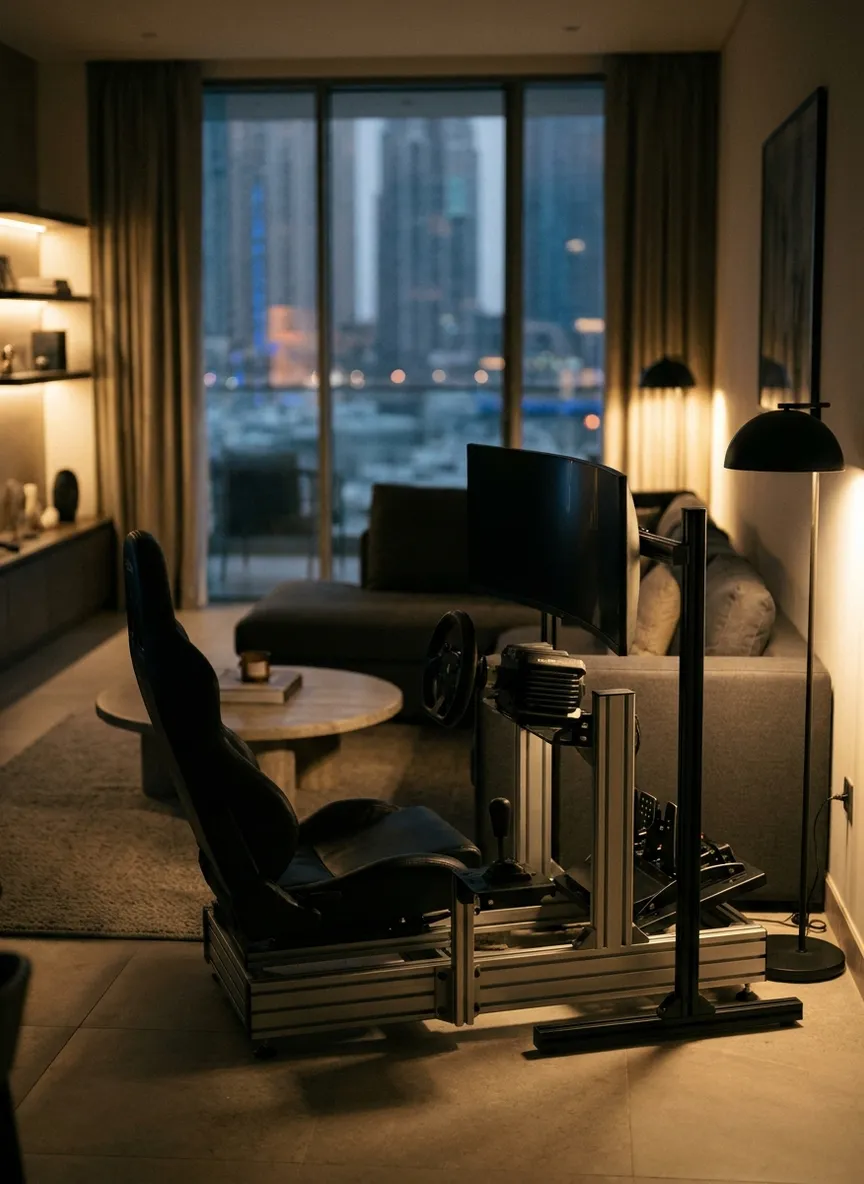 How Much Does a Racing Simulator Cost in Dubai?
A clear breakdown of racing simulator prices in Dubai, from entry-level gear-driven wheels to professional direct drive rigs, and the costs people forget.
Read more →
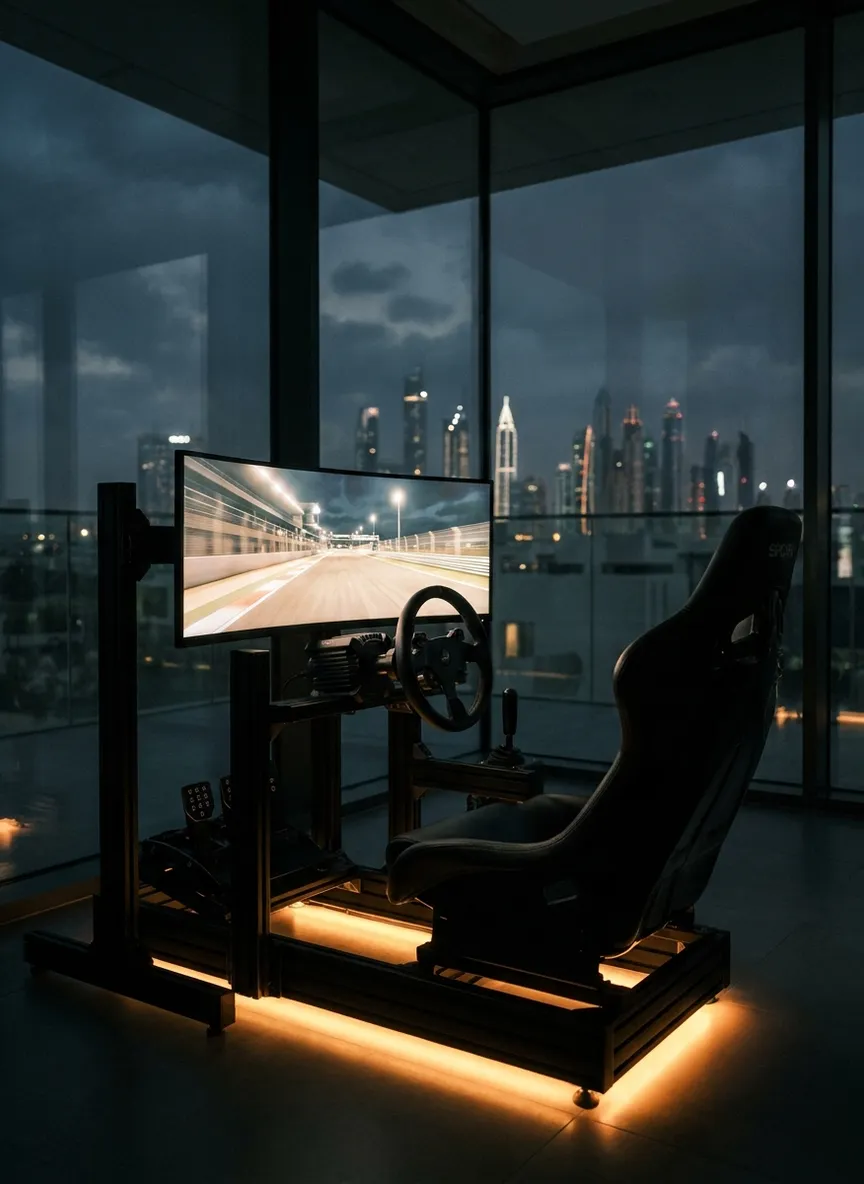 The Best Racing Simulator Setup for Home in 2026
A specification guide to building a home racing simulator in 2026, from wheelbase torque to display strategy, with a good/better/best comparison table.
Read more →
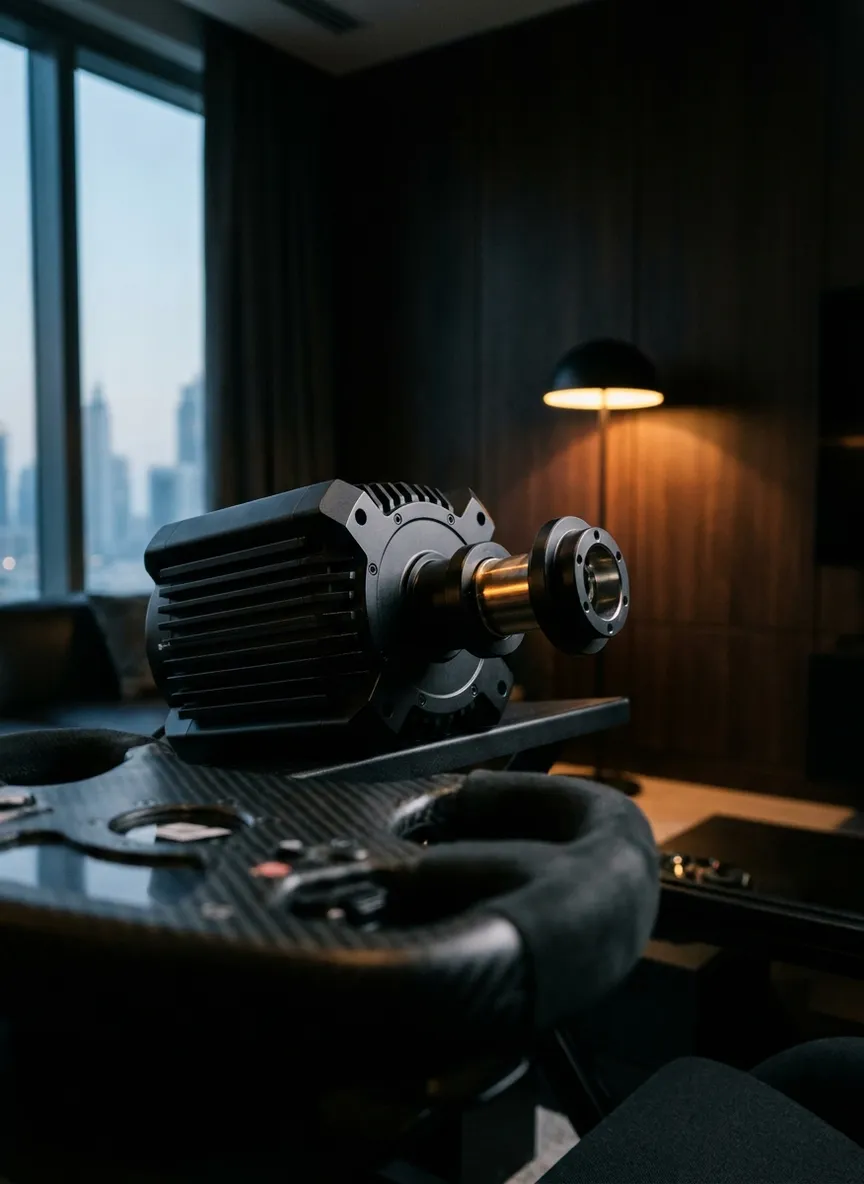 Direct Drive vs Belt Drive Racing Wheels: What's the Real Difference?
Gear, belt, and direct drive wheels explained in plain language, covering torque, feedback detail, noise, and which one actually suits how you drive.
Read more →
Ready to build your racing room?
Book a free, no-obligation consultation. We'll scope your space and come back with a clear plan.